Showing posts with label Columbia. Show all posts

Thursday, January 15, 2015

Sierra snows; skiing, boarding, XC, snowshoeing or sledding, just two hours from Stockton or Modesto!

View from Bear Valley's Day Lodge, looking northwest towards the Mokelumne River Valley.

A hungry lunch crowd enjoys the colorful Day Lodge at Bear Valley Resort.

Members of the 'Ski Bears' enjoy a lesson, with Bear Valley's Day Lodge in distance.

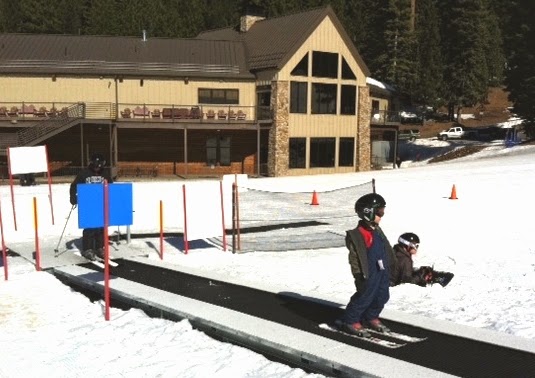
New skier takes the gentle carpet lift in front of the Dodge Ridge Family Lodge.

Members of the Dodge Ridge 'Kid's Club' enjoy a lesson on a sunny day.

A family of five enjoys both the snow and the scenery in the Boulder Creek Canyon area of Dodge Ridge Ski Area.
For Christmas, perhaps you received new skis or a snowboard, snowshoes or cross-country skis and want to try them out. Or, now that the holidays are past, you finally have time to get up to the Sierra snow country.

From Stockton, the two "closest snows to home" are Dodge Ridge Ski Resort 30 miles east of Sonora on Highway 108, and Bear Valley Ski Resort, 50 miles east of Angel’s Camp on Highway 4.

From my home in North Stockton, Dodge Ridge is 98 miles, Bear Valley, 106 miles – considerably closer than other options in the Sierra and Lake Tahoe areas Each resort is family-friendly, generally less expensive than resorts in the Tahoe area, offer good conditions at this point in early January – with each only about two hours from Stockton or Modesto.

Bear Valley Ski Resort is just off Hwy. 4, sports a top elevation of 8,495’, a mid-way day-lodge at 7,750’ and bottom elevation (the Grizzly Chair) of 6.595’.  Bear offers 1680 acres when fully open; with 8 chairlifts (one a high-speed quad) and two carpet lifts, with snow-making on some of its upper slopes.  Currently Bear has a 34+ inch base, is running six chairs and is about 47% open with packed powder conditions.
.
For scenic runs, try several off of Bear Top, where views can stretch south to Dodge Ridge and down into the Mokelumne River Valley.  Additionally, the Bear Valley Cross-country Center at Bear Valley Village (el. 7,100’) offers XC skiing and snowshoeing; they also rent platters, tubes for snow play.

Bear Valley spokesperson Rosie Sundell notes that “excitement is in the air, with recent new ownership by Skyline Investments.  Despite just acquiring the ski area, Skyline has invested in additional snow making equipment and has moved quickly to offer live music each weekend (Tracy native Megan Slankard plays on the Martin Luther King weekend; see Bear’s web site for a listing of coming events)”.

Bear Valley offers a variety of food and drink choices at its mid-way Day Lodge, including delicious outdoor BBQ when we visited last week.  Several dining options are offered nearby.  In Bear Valley Village, the Lodge offers light fare in the Grizzly Lounge and steaks and seafood in the classy Creekside Dining Room and has recently updated the Lodge’s Trattoria, with pizza, pasta and libations, for taking a large family with big appetites! 

A bit closer to the Valley, one can find numerous dining options in Arnold, and even more good eats in Murphy’s, including the highly rated Alchemy Restaurant and the historic Murphy’s Hotel.  Arnold and Murphys both offer a variety of hotels and motels for overnighting.

Dodge Ridge Ski Resort is just off Hwy 108 above Pinecrest Lake, with 8 chairlifts (one quad), one T-bar, two carpet lifts and a rope tow, a top elevation of 8,200’, base of 6,600’; 67 runs and 862 acres when fully open.  Earlier this week, the area reports sunshine, packed powder, plenty of groomed runs and 75% of their terrain open, including chairs 7 and 8.

Spokesperson Sean Waterman notes the area was “delighted to have opened on December 17, and experienced a fun and busy holiday season”.  He notes that the mountain is gearing up for several events, and the fast-approaching Martin Luther King’s birthday weekend. “Bring the family, we look forward to seeing you”, he adds!

Dodge Ridge prides itself on being a family-focused area, further enhanced when it opened its new Family Lodge a few years ago.  The area offers a variety of gentle slopes for beginning skiers and snowboarders and challenging “double black diamond runs” off Chair 8 in the Boulder Creek Canyon area. Check the stunning scenery serviced by Chair 8, with both easy and energizing runs and a view north into the Sierra that is spectacular.  Graceland is a favorite run, scenic, rated “blue” (more difficult) and a family favorite for both schussing and photos!

A number of cross-country ski trails emanate from the Dodge Ridge base area and access road. 
The resort is not permitted for sledding or tubing, but you can visit the Family Lodge, have lunch or hot chocolate and consider skiing, snow-boarding or a fun lesson.  The area around Pinecrest Lake (just below Dodge Ridge) offers several places where you can use those sleds or inner tubes, as does Leland Snow Play area, seven miles further east, just off Highway 108!

Dodge Ridge offers a number of dining options at the ski area, including the Creekside Lodge and Café, with a large variety of food and drink. On weekends and holidays, the North Fork Bistro in the Family Lodge is a great place for families to dine, and slopeside dining is also offered at Local’s Café, with tasty BBQ at the bottom of Chair 7.

Other reliable dining options are found nearby: The Pie Pizza in Sugar Pine, Mia’s Italian in Cold Springs or The Steam Donkey (steaks, seafood, pastas) in Pinecrest. Overnight lodging is found at Pinecrest Lake Lodge or Pinecrest Chalet in Pinecrest, the Christmas Tree Inn in Mi Wuk Village or the Long Barn Lodge in Long Barn, all along Hwy 108. 

If you are seeking snow play, with sleds, tubes or platters, you can find areas on the approach to both ski areas; however snow levels can vary by the day.

How to get there: The start of the route from Stockton is the same for both destinations; take Highway 4 east to Copperopolis.  There, to reach Dodge Ridge, go right/south on O Bryrne’s Ferry Road, then left/east on Highway 108 to the ski area. For Bear Valley, stay on Hwy. 4 all the way to the ski area.

What to take: Pack cold weather gear, binoculars, camera, snacks for the trip and chains are always advised for winter weather.

What’s nearby: Calaveras Big Trees State Park along Hwy. 4; Columbia State Historic Park just off Hwy. 49 (a Gold Rush town preserved) and Jamestown’s Railtown 1897 (the Sierra Railroad) just off Hwy. 108.

For more information: Bear Valley Ski Resort, www.bearvalley.com, 209.753.2301; Dodge Ridge Ski Resort, www.dodgeridge.com, 209.965.3474.

For additional travel destination inspiration, see my blog: http://blogs.eSanJoaquin.com/Valley travel; to contact me, tviall@msn.com.

Think snow, and happy winter travels in the West!

Tuesday, December 24, 2013

Tuolumne City, CA and Westside Lumber Company; Gold Rush and lumber capital

Tuolumne City preserves remnants of the old Gold Rush town of Summersville, as well as lots of pieces of its longer-lasting hay-day as a logging and lumber center of the Mother Lode. Just six miles from Highway 49 and regional center Sonora, it offers history, and fun at nearby Black Oak Casino, for all ages, from one to 100!
Huge old Steam Donkey awaits bygone lumbering operations next to Tuolumne Fire Station

Eves of the Westside Lumber main mill reflect its closure some 50 years ago

The old Westside Lumber Mill building is in a stage of accelerated disrepair, having closed in the early 60s

Tuolumne City's Memorial Auditorium is in use as a town gathering hall

Massive old lumber equipment dots the fields around the Toulumne City boundaries

Westside Lumber's Engine #2 is preserved in the city's park
Westside Lumber at height of its operations (photo courtesy of Tuolumne Museum)
Early history: Tuolumne began in 1854 when Franklin Summers and family settled nearby and built a cabin and began to grow crops. In 1856 James Blakely arrived and discovered the first quartz outcropping, which would become his “Eureka” quartz and gold mine. Soon the initial town of Summersville had taken shape, with shops, restaurants and service providers.

Other nearby mining towns would spring up (and then disappear), Lone Gulch, two miles south, and Cherokee, two miles north. Later named Cartersville, then Tuolumne City, the placer gold would quickly be mined out, and the area became both an agricultural center and the heart of logging and lumber production for cities in the valley like Modesto and Stockton.

Of several logging operations, the Westside Lumber Company became the main player, building a narrow gauge railroad into varied portions of the Sierra forest, buying and uniteg several other narrow-gauge Sierra railways and developing a major lumber mill with regional innovations. It would continue to expand its railroad, the size and complexity of its mill, and develop Tuolumne City into a lumber town of major proportions in the first sixty years of the 20th century. The mill closed in the early 1960s, after a major fire during a labor dispute - the town has struggled to maintain its viability since.

More recent history: Today, portions of the lumber empire of the Westside Lumber Company take center stage. Several of the company’s buildings remain, though in states of disrepair. Remnants of logging equipment dot the town, from a huge Steam Donkey next to the fire station, to pieces of lumbering equipment in varied fields on the edge of town, the lumber company’s Steam Engine #2 in the city park, to the city’s Municipal Auditorium and the local museum. There is much to explore in a short walk of a few to a dozen blocks. A mile to the north east is the huge, new Black Oak Casino, which is bringing new vitality and visitors to the area, and pumping investment into the town as well.

What to do while there: Walk the historic streets, see the old lumber company remnants, tour the city’s museum (open Saturdays and Sundays, 1-4 PM excluding holidays, at 18663 Carter Street, (209) 928-3516; http://tuolumnemuseum.wordpress.com/), and visit the Tuolumne-band of the Miwuk Indian’s Black Oak Casino (www.BlackOakCasino.com; just a mile from the city center).

How to get there: Tuolumne City is located just off historic Highway 49, six miles southeast of the regional city of Sonora by following Tuolumne Road. It is just two hours from Sacramento and one hour from Stockton and Modesto.

Nearby attractions: Nearby Gold Rush towns like Sonora, Twain Hart, Columbia and Jamestown make for a nifty collection of historic towns in the Mother Lode; many will make their trip several days to take in the rich history and scenic beauty of the Sierra foothills. And the Black Oak Casino is worth a visit, with fun for all.

Lodging, camping, dining options: While Toulumne City offers no hotels or motels, nearby Black Oak Casino offers hotel accommodations, several cafes and a fine restaurant, the Seven Sisters. Sonora, just six miles away, offers a wealth of motels, hotels, bed and breakfasts and a number of good to fine restaurants. Campgrounds can also be found along Highway 49, and up Highway 108 in the Sierras.

For additional weekend getaway ideas in California and the west, go to http//LittlePlacesIKnow.blogspot.com.

Sunday, December 15, 2013

Columbia, CA, gem of the Mother Lode and living history park!

Today, Columbia State Park preserves the old Gold Rush town of Columbia as a museum of living history! Open seven days a week, all year, the park offers activities and history for all ages, from one to 100!


The Wells Farge stage still serves up fun rides to Columbia visitors


Columbia's main street is lined with historic buildings and staffed by friendly guides and docents to recreate life in Gold Rush mining town of the 1850s

Columbia's Fire House was built to prevent future fires that all but destroyed
the town in 1854 and 1857, before most structures were rebuilt in brick with fire-safety in mind

Two young prospectors learn to pan for gold, or, at least, agates!

The Wilson-McConnell House dates to the 1870s, and was used in the film 'High Noon'


On sunny afternoons, lots of families with kids line up to try their hand panning for gold!
History: Columbia took root in March, 1850, when Dr. Thaddeous Hildreth, his brother and others settled here and began prospecting for precious gold. Soon, Hildreth Diggin’s was prospering and in weeks more than a 1,000 miners had turned out into the area. The gold camp was initially named American Camp, and, eventually, Columbia.

The immediate challenge was a steady water supply, used to both wash down gold out of hillsides and to sluice gold out of gravel deposits. Because no steady streams were nearby, by 1851 the locals had formed the Tuolumne County Water Company, to bring water to the town. Since its rates were deemed too high, in 1854 another company was formed, the Columbia and Stanislaus River Water Company, to bring water from 60 miles distant.

By the late 1850s, the two had merged, and use of the water began to change the landscape. It is estimated that the current park parking lot, and area where kids pan for gold was once 25-30 feet higher, before water was used to wash the gold out of the soil and gravel!  All told, approximately $87 million (at 1860's prices) came out of the mines around Columbia!

Within years of its founding, the prosperous town had streets well laid-out, and well over 100 shops, saloons, bakeries, blacksmith shops and restaurants were catering to thousands of miners and townsfolk. Columbia would add churches, the Sons of Temperance, a Masonic Lodge, hotels and a concert hall; the town's population would swell to almost 6,000 towns people. 

Originally, almost all the buildings were made of wood, and a huge fire swept the city in 1854, destroying most of the wooden buildings in the business district. Most of these were rebuilt in 1855, but a second fire in 1857 destroyed more framed buildings and some of the brick ones; the town again rebuilt and further emphasized state-of-the-art fire suppression and fire-fighting.

By the early 1860s, most of the easiest placer gold had been tapped out, and the town began a slow decline. In the following 20-some years, many of the vacated buildings were torn down, and their sites were mined for gold. By the late 19th century and into the 20th, the town was in visible and steady decay - residents had dropped to just 500.

Recent history: An idea born in the Roaring 20s took hold, to establish and renovate Columbia as a State Park, an idea that was finally made reality in 1945! Today, Columbia’s business district is closed to all but foot traffic, and a host of businesses, shops and volunteers bring the town to life, much as it appeared in 1855!

What to do while there: Take a stage coach ride, pan for gold, tour blacksmith and livery shops, get a free tour led by period-dressed docents, grab lunch or an ice cream, and take in life as it was more than 150 years ago! Best of all, admission, parking and guided tours are free, so a day spent here is easy on the wallet!

How to get there: Columbia is located just off historic Highway 49, and is just two hours from Sacramento and 1.5 hours from Stockton.

Nearby: Gold Rush towns like Angels Camp, Amador City, Sutter Creek, Sonora, Tuolumne City and Jamestown make for a nifty collection of historic towns in the Mother Lode; many will make their trip several days to take in the rich history and scenic beauty of the Sierra foothills.

To plan your visit, go to www.visitcolumbiacalifornia.com or call the State Park at (209)-588-9128. For additional weekend getaway ideas in California and the west, go to http//LittlePlacesIKnow.blogspot.com.

Wednesday, October 30, 2013

Sutter Creek, CA; rich in Gold Rush history

Two years before gold was discovered at Coloma in 1848, John Sutter sent out a party from Sacramento in search of timber. They found a grove rich in sugar pine and named one of the nearby streams Sutter’s Creek. Soon placer mining was in full swing, quite a village had sprung up and deep rock mining of rich ore deposits soon followed.


Photos, from top down: Hotel Sutter/Bellotti Hotel, Knight's Foundry, Methodist Church, one of many old homes surrounding downtown Sutter Creek, and Main Street looking southeast.

Incorporated in 1854, Sutter Creek was home to several hotels, saloons, dry-goods shops and churches. Today, just off Highway 49 and north of Jackson, Sutter Creek is one of the best-preserved of the California Gold Rush towns. Quaint Main Street (part of Highway 49 until a bypass skirted traffic around the city five years ago) offers a walkable stretch with a wealth of historic buildings dating from the 1850s.

Some of the more impressive include the Hotel Sutter/Bellotti Inn. Opened in 1860, it is one of the oldest hotels still in continuous operation in the state. The American Exchange Hotel preceded the Bellotti on this site, opening in 1858 and soon replaced by the Bellotti.

Two blocks south, Sutter Creek Methodist Church was constructed 1861, under leadership of Rev. I. B. Fish, and incorporated in 1862; the steeple was added in 1976 (church located at the corner of Main and Church). Main Street offers scores of historic edifices, many of them marked by plaques offering historical anecdotes – all of them home to busy shops, restaurants and wine-tasting rooms.

Just three blocks east of Main on Eureka is the old Knight Foundry. It was the only water-powered foundry in the US, that, until a few years ago, was in continuous operation since 1873. Sam Knight designed the water wheel which was used world-wide, often powering early hydroelectric plants throughout California, Utah and Oregon.

Seven-foot versions of the Knight water wheel powered the big stamp mills in gold mining days. The 42 inch model, used on Sutter Creek on the south side of the foundry, helped in manufacture of the heavy dredge buckets used on the San Francisco Bay, San Joaquin Delta and Seattle harbors, then hauled by freight wagon and mule teams to the railroad and shipped to their destination.

Sutter Creek is home to a baker’s dozen of bed and breakfasts and motels, with scores of quaint shops and restaurants.  For a great resource, go to www.suttercreek.org; the site also offers a host of annual events, such as the November 9 Winefest on historic Main Street! Take a day or weekend trip to Sutter Creek soon and revel in Gold Rush history!  For other quaint California and western getaways, go to http://littleplacesiknow.blogspot.com/.

Friday, August 23, 2013

Copperopolis, CA offers glimpse of old copper and gold mining in Sierra foothills!


While Copperopolis, CA, just 30 miles east of Stockton on Highway 4 in the Sierra foothills, is best known as a copper producer, gold was discovered here in 1858 - two years before the copper discovery.

By 1974, the Madame Felix Mining District, just north of town, had produced over 200,000 ounces of gold. In the 1980s, the Meridian Gold Company re-started the mining operation, and produced another 300,000 ounces of gold; all told, gold worth $800 million at today’s prices!

Start your tour at Copperopolis Park on the O’Brynes Ferry Road in the heart of old town, with a wealth of old mining machinery from the late 1880s to the early 20th century and outdoor displays that explain the history of the copper and gold mining days. You’ll see old photos and history of the Old Corner Saloon, the Congregational Church, old Armory (now home to Copperopolis Olive Oil), Copperopolis Hotel and other Gold Rush-era buildings, all of them still standing.

At the south end of town (O’Brynes and Telegraph intersection), see massive tailings, the remnants of the huge copper smelter that operated here until 1929. Then take Telegraph Road 3/4s of a mile west to the new Town Center, where a new Town Square commercial center was built five years ago. In the heart of the center is a cute bandstand, surrounded by interesting shops and good food options such as Panini’s Italian, Griff’s BBQ, Cruisers Ice Cream and Snaps Coffee and Wine Bar. This is a great place for kids to play on the village green and adults to window shop!

From town, scenic Lake Tulloch is just six miles south and Saddle Creek Golf Course just four miles for those golfers seeking challenge. For a scenic route back to the San Joaquin Valley, take the Rock Creek Road north to Salt Springs Reservoir, with nice park and picnic area on the west shore, and continue on the road, where a one-lane, bumpy but scenic road drive brings you out at Milton in the low foothills. Watch for wild turkey sightings on this drive, and, maybe bobcats or coyotes if you are vigilant!

For more insights into N. and Central California, go to my blog: LittlePlacesIKnow@blogspot.com.
Copperopolis historic park tells tales of the mines and features old mining equipment, picnic area
Huge old winch once worked in the copper mines around the city

Copperopolis's new Town Center offers quaint shops, fine restaurants and weekend activities in pretty city park in front of the new Town Hall; it's just a half-mile from old Copperopolis!